Every call, chat, email, or message your customers send is packed with insight. Most contact centers only use a fraction of that value. Contact center artficial intelligence changes that by turning raw interactions into real-time guidance, smarter decisions, and better customer experiences. By leveraging a voice bot with artificial intelligence – bot de voz con inteligencia artificial, these platforms not only handle routine inquiries but also support agents in making informed decisions. This approach shows how AI supports expanding customer teams, allowing them to respond efficiently to increasing demand without compromising service quality.
Instead of simply handling volume, an intelligent contact center learns from every interaction, anticipates customer needs, and empowers agents to deliver faster, more helpful support. The result is a powerful combination of happier customers, more productive agents, and lower operating costs.
Transforming Customer Experience with Advanced Computing Platforms
Modern contact centers are increasingly powered by AI-enhanced computing ecosystems, which bring the capabilities of cloud computing into seamless operation. These platforms allow organizations to store, analyze, and act on vast volumes of customer data in real time. By integrating predictive analytics and AI-driven recommendations, agents can resolve issues faster, and automated systems like voice bot with artificial intelligence can handle routine inquiries efficiently.
Empowering Agents with Next-Gen Tech Tools
The backbone of an intelligent contact center is cutting-edge technology infrastructure, which encompasses AI-assisted desktops, machine learning algorithms, and real-time analytics. This environment supports agents by providing context-sensitive guidance during every interaction, helping them deliver personalized service. By using these tools, businesses see measurable improvements in response times and customer satisfaction.
Revolutionizing Marketing Strategies with AI Insights
Today, AI-driven customer engagement strategies transform how organizations approach marketing. By analyzing patterns from calls, chats, and emails, companies can identify upsell opportunities, predict customer behavior, and tailor campaigns effectively. Integration with contact center intelligence ensures that marketing actions are directly informed by real customer interactions, creating a seamless loop between service and promotion.
Optimizing Campaigns through Intelligent Marketing Solutions
Beyond traditional methods, intelligent marketing automation platforms allow teams to deliver the right message at the right time. These AI-powered systems analyze past interactions, segment audiences, and suggest personalized offers, reducing wasted effort and increasing conversion rates. For expanding teams, this means leveraging technology to reach more customers without overextending human resources.
Driving Financial Decisions with AI
Financial management within contact centers benefits from AI-enabled financial analytics systems, which help track costs, forecast resource needs, and optimize operational budgets. Real-time insights allow managers to make strategic decisions that balance customer experience with cost efficiency. By applying AI to financial data, organizations can scale intelligently while keeping operating expenses in check.
What Is Contact Center Intelligence?
Contact center intelligenceis the use of AI, analytics, and data integration to understand and optimize every customer interaction across all channels. It brings together technologies like speech analytics, machine learning, natural language processing, and automation to help you:
- See what customers really want and feel in every conversation.
- Guide agents in real time with next-best actions and knowledge prompts.
- Automate routine tasks and common questions with intelligent self-service.
- Predict demand, plan staffing, and route inquiries more effectively.
- Continuously improve quality, compliance, and customer satisfaction.
Instead of relying on a few recorded calls or manual reports, contact center intelligence gives youalways-on insight at scaleacross voice, chat, email, messaging, and social channels.
Top AI Contact Center Solutions to Enhance Customer Experience
Choosing the right AI-powered contact center solution can dramatically improve customer satisfaction, agent productivity, and operational efficiency. Here are the leading platforms that businesses rely on to deliver intelligent support:
- Bright Pattern
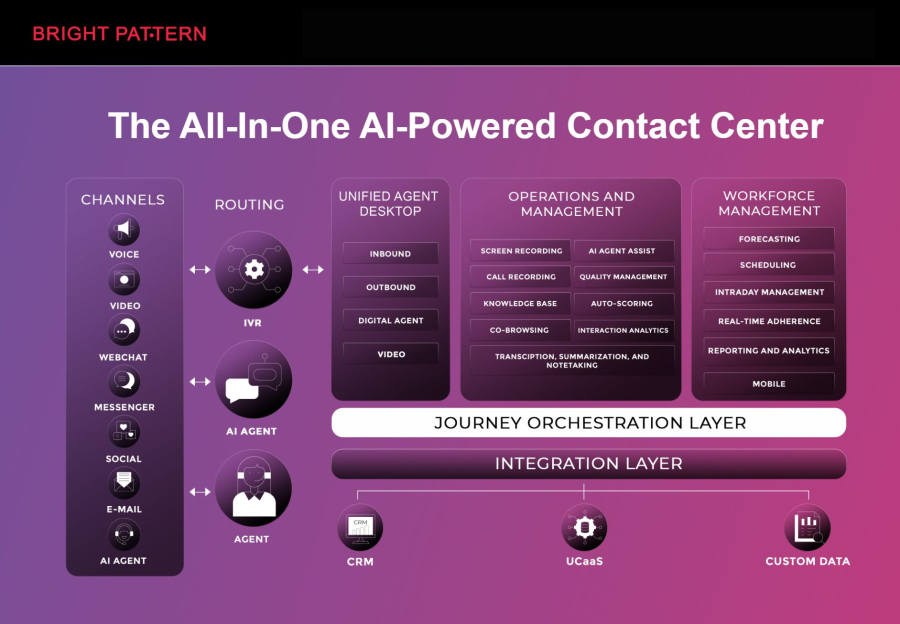 Bright Pattern leads the market in contact center intelligence solutions. Its platform integrates a voice bot with artificial intelligence, omnichannel routing, and real-time analytics to empower agents and improve customer experiences. With features like AI-assisted scripting, sentiment analysis, and predictive routing, Bright Pattern ensures faster resolution times, reduced operational costs, and happier customers. Organizations can scale effortlessly while using AI to support expanding customer teams. Its intuitive interface and seamless integration with CRMs and marketing automation tools make it a top choice for businesses of all sizes.
- Five9
Five9 offers cloud-based AI contact center solutions that help businesses automate routine tasks, optimize agent performance, and improve customer engagement. Its AI tools provide predictive dialing, analytics, and intelligent routing.
- Genesys Cloud CX
Genesys Cloud CX delivers omnichannel AI capabilities, including chatbots, voicebots, and advanced analytics. It focuses on improving customer experience through predictive insights and personalized interactions.
- NICE inContact CXone
NICE inContact CXone leverages AI to provide intelligent routing, analytics, and automation. It enables businesses to optimize workforce performance and enhance overall service efficiency.
- Talkdesk
Talkdesk uses AI-driven tools to streamline contact center operations, including real-time coaching for agents, sentiment analysis, and automated workflows.
- Zendesk
Zendesk incorporates AI features like automated ticket triaging, chatbots, and analytics to support agents and deliver faster customer resolutions.
- Amazon Connect
Amazon Connect is a cloud-based contact center service with integrated AI services such as Lex for conversational interfaces and predictive analytics for smarter decision-making.
- Avaya OneCloud CCaaS
Avaya OneCloud combines AI, analytics, and omnichannel support to optimize contact center operations and improve agent productivity.
- RingCentral Contact Center
RingCentral provides AI-enhanced tools for customer engagement, including chatbots, analytics, and workflow automation for more efficient support.
- 8x8 Contact Center
8x8 offers cloud contact center solutions with AI features like sentiment analysis, predictive analytics, and workforce optimization tools to enhance customer experiences.
How Contact Center Intelligence Works: Core Components
While every solution is different, most intelligent contact center ecosystems share several core components that work together.
1. Data Collection Across Every Channel
The starting point is capturing data from every place customers interact with you, including:
- Phone calls and IVR interactions.
- Live chat and messaging conversations.
- Email tickets and support forms.
- Social media and review platforms, when integrated.
Modern platforms bring this into a centralized environment so you can analyze not just one channel, but theentire customer journey.
2. Speech and Text Analytics
Once interactions are captured,speech analyticsandtext analyticsconvert conversations into structured data:
- Transcribing voice calls into searchable text.
- Detecting key topics, intents, and recurring issues.
- Recognizing sentiment and emotion signals.
- Flagging keywords related to compliance or high-risk situations.
This layer turns thousands of calls and chats into clear patterns you can act on.
3. AI and Machine Learning Models
AI models analyze that data to understand behavior and recommend actions, such as:
- Identifying the reason for contact and likely next questions.
- Predicting which customers are at risk of churn or dissatisfaction.
- Matching customers to the best agent based on skills and history.
- Suggesting personalized offers or retention steps.
Over time, these models learn from new data, so your contact center becomes smarter and more accurate with every interaction.
4. Intelligent Routing and Orchestration
With better understanding of customer needs, intelligent systems can:
- Route contacts to the best available agent based on skills, language, and complexity.
- Decide when to keep a customer in self-service versus transferring to a human.
- Prioritize high-value or high-risk customers for faster handling.
The result isshorter wait times, fewer transfers, and more first-contact resolutions.
5. Agent Assist and Guidance
One of the most visible aspects of contact center intelligence is real-time support for agents, including:
- Knowledge suggestions based on what the customer is saying or typing.
- Auto-populated summaries and after-call notes to reduce wrap-up time.
- Real-time prompts for compliance language and required disclosures.
- Sentiment indicators that highlight when a conversation needs extra care.
Agents spend less time searching for answers and more time engaging customers with confidence and empathy.
6. Analytics, Dashboards, and Reporting
On the management side, contact center intelligence delivers deep, visual insight into performance:
- Customer sentiment trends and emerging issues.
- Top drivers of contact volume and repeat calls.
- Agent performance and coaching opportunities.
- Operational metrics like handle time, occupancy, and service level.
Leaders get a single source of truth for contact center performance, helping them makefaster, data-driven decisions.
Business Benefits of Contact Center Intelligence
Implementing contact center intelligence creates value across your organization. While every operation is unique, several benefits show up consistently.
1. Stronger Customer Experience
- Faster answersthanks to smarter routing and better preparation before agents pick up.
- More accurate resolutionsas agents receive real-time guidance and relevant knowledge.
- Less frictionbecause customers avoid repeating information or being passed between departments.
- More personalized servicebased on history, sentiment, and preferences.
When every interaction feels easier and more tailored, loyalty and satisfaction naturally rise.
2. Higher Operational Efficiency
- Reduction in average handle time through targeted prompts and automation of routine tasks.
- Better self-service containment for simple requests, freeing agents for higher-value interactions.
- Improved forecasting and staffing by understanding real demand patterns.
- Fewer repeat contacts because the root cause of issues is clearly visible and can be addressed.
These gains translate intolower cost per contact and more capacitywithout necessarily increasing headcount.
3. Empowered and Engaged Agents
- Less time spent on tedious tasks like manual notes and searching multiple systems.
- Increased confidence from having contextual insights and suggested responses at their fingertips.
- Fair, data-backed coaching based on full interaction history, not a handful of sampled calls.
- Clear visibility into their own performance and progress.
Happier, better-supported agents deliver better experiences and are more likely to stay with your organization.
4. Revenue Growth and Retention
- Proactive identification of at-risk customers, enabling timely retention offers.
- Smarter upsell and cross-sell recommendations during service conversations.
- Better conversion rates from service-to-sales opportunities when agents have instant context.
Every contact becomes an opportunity to strengthen relationships and grow lifetime value.
5. Stronger Compliance and Risk Management
- Automated monitoring of 100% of interactions for required disclosures and sensitive phrases.
- Early detection of emerging issues before they scale into larger problems.
- Detailed audit trails and evidence for regulatory requirements.
Instead of manually sampling a small number of calls, you gainfull visibilityinto how your policies are applied every day.
High-Impact Use Cases for Contact Center Intelligence
To see the potential more clearly, it helps to look at practical, high-value use cases that organizations commonly start with.
1. Real-Time Agent Assist
Real-time agent assist tools listen to or read the conversation and surface helpful guidance instantly, such as:
- Relevant knowledge base articles or troubleshooting steps.
- Customer-specific information pulled from CRM systems.
- Suggested language for sensitive or complex topics.
- Compliance prompts for regulated interactions.
This dramatically shortens the learning curve for new agents and helps experienced agents handle complex scenarios with greater ease.
2. Intelligent Self-Service and Virtual Agents
AI-powered virtual agents and chatbots can now handle a wide range of routine inquiries, including:
- Account and order status questions.
- Simple changes or updates that can be automated.
- Basic troubleshooting and how-to guidance.
Because these virtual agents are trained on the same intelligence as your live agents, they become more accurate and helpful over time. Customers get24/7 instant support, and your human team focuses on issues that truly require their expertise.
3. Predictive and Skills-Based Routing
Routing is no longer just about who is available. With intelligent routing, you can consider:
- Customer profile, history, and past sentiment.
- Agent skills, performance, and experience with similar cases.
- The complexity and urgency of the current issue.
This increases the odds that every customer reaches theright person the first time, improving first-contact resolution and satisfaction.
4. Automated Quality Management
Instead of manually reviewing a small sample of calls, automated quality management can analyze all interactions and:
- Score conversations against your quality standards.
- Flag coaching opportunities automatically.
- Highlight top-performing behaviors for others to replicate.
Supervisors spend less time searching for examples and more time actually coaching and developing their teams.
5. Proactive Outreach and Alerts
With clearer insight into patterns, contact center intelligence can support proactive strategies, such as:
- Identifying when a customer is likely to need help based on usage patterns.
- Triggering outreach when sentiment or behavior suggests dissatisfaction.
- Alerting customers to known issues or solutions before they contact you.
Shifting from reactive support to proactive engagement is a powerful way to differentiate your brand.
6. Voice of the Customer at Scale
Every conversation is unfiltered customer feedback. With AI-driven analytics, you can:
- Spot recurring pain points and process gaps.
- Understand how product changes impact satisfaction.
- Share insights across marketing, product, and operations teams.
Your contact center becomes a strategic engine for customer insight, not just a cost center.
Key Capabilities to Look For
When evaluating contact center intelligence solutions or building your own ecosystem, it helps to have a clear checklist of core capabilities.
| Capability | Why It Matters |
| Omnichannel data integration | Ensures a unified view of the customer journey across voice, chat, email, and more. |
| Speech and text analytics | Turns unstructured conversations into actionable insight and searchable data. |
| Real-time agent assist | Boosts accuracy and speed during live interactions, especially for complex cases. |
| AI-powered self-service | Automates common requests to reduce volume and offer instant 24/7 support. |
| Intelligent routing | Matches each customer with the best available resource, improving outcomes. |
| Quality and compliance monitoring | Scales quality assurance and reduces risk by analyzing all interactions. |
| Configurable dashboards and reports | Gives leaders and supervisors clear, role-based visibility into performance. |
| Open integrations | Connects with CRM, workforce management, and other core systems. |
| Security and privacy controls | Protects customer data and aligns with regulatory requirements. |
Implementation Roadmap: How to Get Started
You do not need to transform everything at once to benefit from contact center intelligence. A phased approach helps you deliver quick wins while building long-term capability.
Step 1: Clarify Your Business Goals
Start with clear outcomes rather than technology features. Common goals include:
- Reducing average handle time or cost per contact.
- Improving first-contact resolution and customer satisfaction.
- Increasing agent productivity and lowering attrition.
- Strengthening compliance coverage and reporting.
Prioritizing goals shapes your roadmap and helps you measure success from day one.
Step 2: Assess Your Current Environment
Take stock of what you already have:
- Contact center platform and channel mix.
- CRM, ticketing, and knowledge management systems.
- Existing analytics, reporting, and quality processes.
- Data governance and security practices.
This assessment reveals integration needs, data gaps, and quick-win opportunities.
Step 3: Choose High-Impact Pilot Use Cases
Focus your initial efforts on use cases that are:
- Visible and meaningful to customers or agents.
- Operationally feasible with your current data and systems.
- Measurable in a clear, time-bound way.
Popular starting points include real-time agent assist for a specific queue, automated quality monitoring for a subset of interactions, or an AI-powered virtual agent for a narrow group of common questions.
Step 4: Involve Agents and Supervisors Early
Agents and supervisors are the everyday users of contact center intelligence, so involve them from the beginning by:
- Gathering feedback on pain points and improvement ideas.
- Including them in tool evaluations and pilot design.
- Providing clear training and space for questions.
When the people on the front line see how the tools make their work easier, adoption and results improve dramatically.
Step 5: Measure, Learn, and Expand
Define metrics for your pilot use cases and track them closely. For example:
- For agent assist: handle time, first-contact resolution, and error rates.
- For self-service: containment rate, customer satisfaction, and escalation volume.
- For quality automation: number of interactions reviewed, coaching hours, and quality scores.
Use these insights to refine workflows, update training, and make the case to expand contact center intelligence across more teams and channels.
Essential Metrics for Intelligent Contact Centers
While every organization tracks a unique mix of metrics, intelligent contact centers often focus on a blend of customer, operational, and agent measures.
Customer Experience Metrics
- Customer satisfaction and post-interaction feedback.
- Net sentiment at the interaction and journey level.
- First-contact resolution rate.
- Customer effort and ease-of-use measures.
Operational Metrics
- Average handle time and average speed of answer.
- Abandon rates and queue times.
- Self-service containment and deflection rates.
- Contact volume by channel, topic, and time of day.
Agent Experience and Quality Metrics
- Quality scores and adherence to key behaviors.
- Training completion and knowledge usage.
- Agent satisfaction and retention.
- Coaching frequency and impact on performance.
Contact center intelligence does more than report these metrics; it helps you understandwhythey move and what you can do about it.
Change Management: Turning Technology Into Transformation
Technology is only one part of a successful intelligence strategy. The way you lead change is just as important. Strong change management typically includes:
- Clear communicationabout the purpose of new tools and how they support agents and customers.
- Training and enablementthat focus on real workflows, not just features.
- Supportive leadershipthat uses insights to coach and recognize, not only to monitor.
- Continuous feedback loopswhere agents and supervisors help refine processes.
Handled well, contact center intelligence feels to your team like an upgrade, not a surveillance tool. It becomes a partner that removes friction and highlights their strengths.
The Future of Contact Center Intelligence
Contact center intelligence is evolving quickly. Several trends are shaping the next wave of value:
- Deeper journey analyticsthat connect in-contact behavior with browsing, purchase, and product usage data.
- Hyper-personalizationbased on preferences, context, and predicted needs.
- More natural, conversational AIthat feels less scripted and more human.
- Stronger focus on agent well-beingwith tools that monitor stress signals and workload balance.
As these capabilities mature, the contact center moves from a reactive problem-solving unit to astrategic hub for customer relationships and insight.
Bringing It All Together
Contact center intelligence is not just a new technology trend; it is a new way of running your customer operations. By combining AI, analytics, and human expertise, you can:
- Deliver faster, more accurate, and more personal support.
- Empower agents with the guidance and tools they need to excel.
- Lower operational costs while improving quality and compliance.
- Turn every interaction into insight that fuels smarter decisions across your business.
Whether you operate a small support team or a global contact center network, starting your journey into contact center intelligence today sets you up for stronger relationships, more resilient operations, and a competitive advantage that grows with every customer conversation.
